Week Three Blog Review - The Power of I Don't Know
This week's think piece by Terry Heick, of Teachthought.com, praises an illustration by artist Rebecca Zuniga, inspired by postings of Edutopia contributor Heather Wolpert-Galwan.
The illustration is a cross between a flow chart and a brainstorm, mostly text with some illustrations, identifying an array of attitudes, techniques, and suggestions that help students build a habit of inquiry through teachers willingness to frame their curiosity and encourage the discovery of what a student doesn't know.
Mr. Heick's writing begins with the value of curiosity and inquiry, noting that work through essential questions and discovery of content inspired by curriculum, students can do work that "transcends content," allowing students to learn in contexts they frame beyond the classroom's typical, standard processes. He rightly asserts that questions are more important than the answers they solicit, and that masterful teaching helps students not only learn to answer questions, but also to discover their own useful questions.
Heick closes with a scenario in which a student is seeking information from an imaginary teacher. The student wants answers from the teacher, but the teacher kindly redirects her to deepen thinking on the topic by asking questions about why things happen. The teacher finishes the exchange by getting the student to wonder why things work, and sends the student off to find the answer for herself.
In our class, especially in our reading, teachers will need redefine their role as it moves from information provider and assessor to skill builder, motivator, and coach. The notion of inquiry, knowing what you don't know and what to do about it, is aptly suited to the powers of technology in the hands of a school, teacher, and student willing to use it wisely and well.
Once again, I find myself compelled by Mr. Heick's choice of topics, impressed with his breadth of sources and readings, and frustrated (less so this time) by his unwillingness to seek samples or evidence to support, reiterate, or usefully expand on the ideas that inspire his writing. His commentary is usefully progressive and eager to share thinking that broadens teachers' awareness of best practice, but so far has only served as philosophical affirmer, not coach or practical advisor.
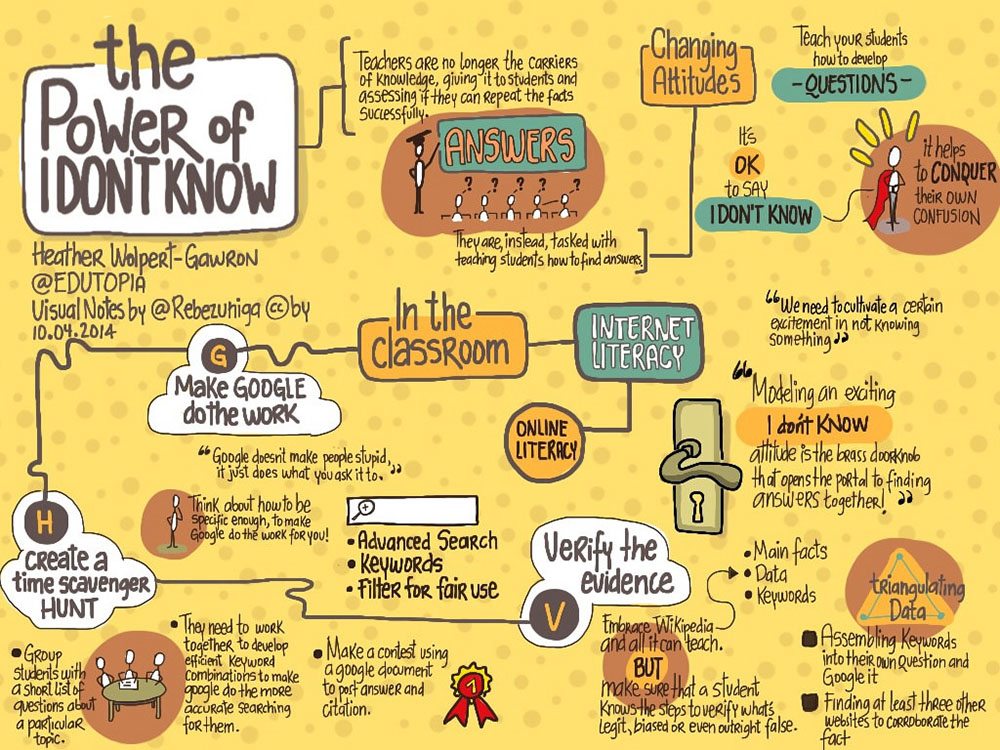
The illustration is a cross between a flow chart and a brainstorm, mostly text with some illustrations, identifying an array of attitudes, techniques, and suggestions that help students build a habit of inquiry through teachers willingness to frame their curiosity and encourage the discovery of what a student doesn't know.
Mr. Heick's writing begins with the value of curiosity and inquiry, noting that work through essential questions and discovery of content inspired by curriculum, students can do work that "transcends content," allowing students to learn in contexts they frame beyond the classroom's typical, standard processes. He rightly asserts that questions are more important than the answers they solicit, and that masterful teaching helps students not only learn to answer questions, but also to discover their own useful questions.
Heick closes with a scenario in which a student is seeking information from an imaginary teacher. The student wants answers from the teacher, but the teacher kindly redirects her to deepen thinking on the topic by asking questions about why things happen. The teacher finishes the exchange by getting the student to wonder why things work, and sends the student off to find the answer for herself.
In our class, especially in our reading, teachers will need redefine their role as it moves from information provider and assessor to skill builder, motivator, and coach. The notion of inquiry, knowing what you don't know and what to do about it, is aptly suited to the powers of technology in the hands of a school, teacher, and student willing to use it wisely and well.
Once again, I find myself compelled by Mr. Heick's choice of topics, impressed with his breadth of sources and readings, and frustrated (less so this time) by his unwillingness to seek samples or evidence to support, reiterate, or usefully expand on the ideas that inspire his writing. His commentary is usefully progressive and eager to share thinking that broadens teachers' awareness of best practice, but so far has only served as philosophical affirmer, not coach or practical advisor.
Comments
Post a Comment